Head of Growth & Strategic Partnerships

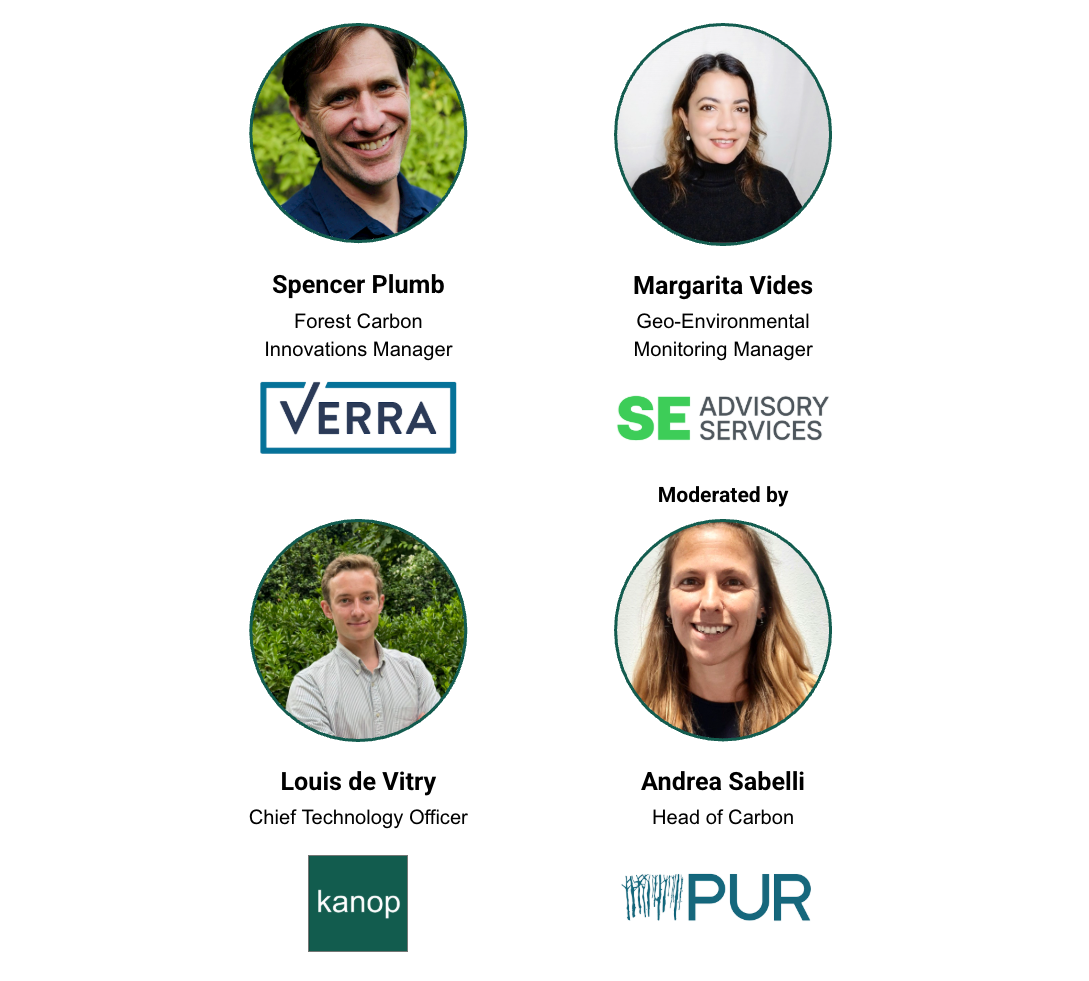
Over 450 professionals joined our deep dive into VM0047 and digital MRV for smallholder ARR projects. The webinar brought together Spencer Plumb from Verra, Louis de Vitry from Kanop, and Margarita Vides from SE Advisory Services, moderated by Andrea Sabelli from PUR. The conversation tackled the practical realities of applying dynamic baselines to fragmented, sub-hectare landscapes, and revealed how remote sensing is making high-integrity carbon projects more accessible to smallholder farmers worldwide.
As carbon markets increasingly demand transparency and scientific rigor, a critical question emerges: can smallholder farmers, who often work plots smaller than one hectare, participate in high-integrity carbon projects? On January 22nd, we hosted a panel to explore exactly this challenge, bringing together perspectives from methodology development, technology provision, and on-the-ground project implementation.
VM0047, Verra's afforestation, reforestation, and revegetation methodology, has become a significant milestone for the voluntary carbon market. As Spencer Plumb, Senior Manager of Forest Carbon and Innovation at Verra, explained, the methodology was developed because previous approaches often failed to capture what would have happened in the absence of a carbon project.
VM0047 addresses this through dynamic baselines, a quasi-experimental design that uses remote sensing to compare project areas with matched control plots over time. This approach has received validation from multiple angles: it was the first nature-based removal methodology to receive ICVCM's Core Carbon Principles label, and its design principles have been adopted by other standards like Isometric and Equitable Earth.
Since its release just over two years ago, 160 projects have enrolled under VM0047. But for smallholder projects, the methodology's technical requirements initially presented barriers, particularly around the minimum plot size for what the methodology refers to as the “area-based approach”.
A significant change in VM0047 v1.1 changed the limiting variable of the area-based approach from project size to planting density; specifically plots with more than 50 trees per hectare. This shift recognized that advances in remote sensing technology now allow detection of vegetation changes at much finer scales than previously possible.
"We saw the opportunity to use remote sensing and the tools that were coming forward to get down to these more granular scales," Spencer noted. "In the long run, this is going to uphold integrity and credibility of smallholder projects better than the census-based approach."
This change, while initially sending ripples through the project development community, has ultimately enabled more inclusive participation. Kanop's 10-meter resolution biomass products, for instance, can now support projects working with sub-hectare plots.
Margarita Vides, Geo-Environmental Monitoring Manager at SE Advisory Services, shared insights from a forest carbon project in India that illustrates both the challenges and solutions for smallholder projects.
The project spans several districts, with a target of 2,300 hectares of plantations distributed across the landscape. The reality on the ground is striking: 68% of farms in India are marginal, meaning less than one hectare. In the project's first planting instance, most participants didn't even reach one hectare.
"When we were collecting farmers that would participate in the project, most of them didn't even reach a hectare," Margarita explained. "We found a workaround: people collectively joining their land parcels so we could reach the minimum size."
The logistics of traditional field-based monitoring in this context are immense. Margarita showed a map where one week of site visits was represented by blue dots of different shades for each day. "This is just visits to plots," she emphasized. "We're not doing measurements, we're not doing inventories."
Without digital MRV, the team faced:
The shift to digital MRV fundamentally altered what's possible for projects like this. Rather than census-based approaches requiring visits to every plot, satellite-based monitoring enables consistent, annual (or even sub-annual) coverage across all participants.
Key benefits the SE Advisory Services team observed:
"We're not using dMRV as a shortcut," Margarita clarified. "These are tools that allow us to be more rigorous and the project to be more feasible. In the end, this is necessary to scale impact."
Louis de Vitry, Kanop's CTO, walked through the technical considerations for applying remote sensing to smallholder contexts. At 10-meter resolution, a rectangular 0.25-hectare plot (50m x 50m) can be covered by 25 pixels. At 25-meter resolution, such a plot would have only 4 pixels.
The choice of stocking index matters significantly. Verra defines a stocking index as any indicator sufficiently correlated with above-ground biomass. While NDVI (Normalized Difference Vegetation Index) is a simple option, it has limitations.
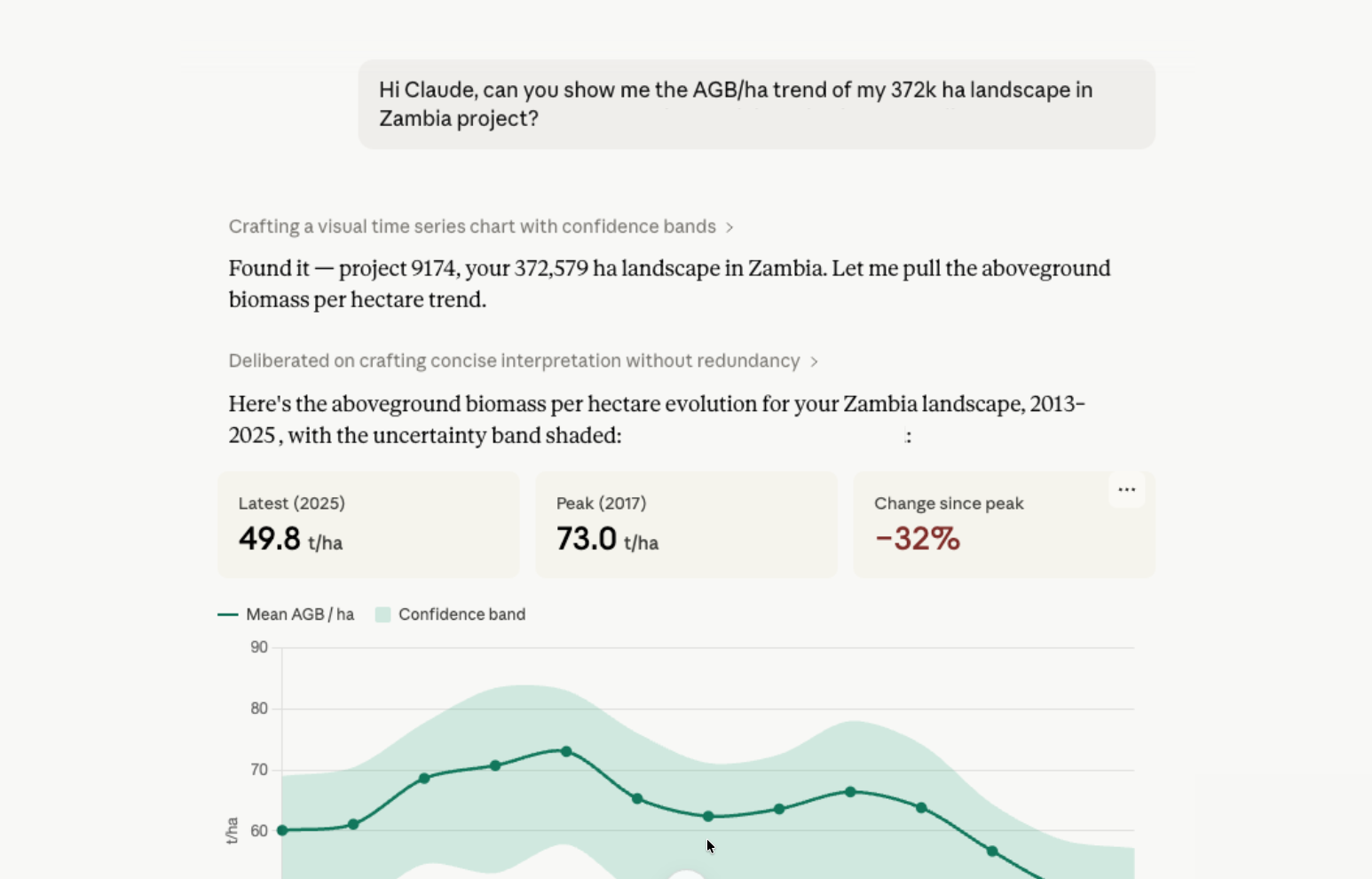
Louis presented two project examples comparing Kanop's AI-derived biomass estimates against NDVI:
In a Senegal project with plots of 1-5 hectares, the AI-derived stocking index showed smoother evolution over time and detected early biomass growth more confidently than NDVI.
In an 8-hectare project with continuous plantations, the difference was even more pronounced. "NDVI is a really noisy estimate," Louis explained. "Even before the start of the project, it varies quite a lot, and at the end it even goes down." The AI-derived estimates, trained on tens of millions of hectares using both optical and radar data, provided more stable and reliable signals.
Several questions from the 450+ attendees revealed common misconceptions about VM0047 requirements that the panel addressed:
Do you need field plots on every enrolled property? No. Spencer emphasized that randomized sampling across strata or annual cohorts is the expectation. "You're only going to select a subpopulation to represent the whole population. You're not going to every single property and putting in plots."
Do you need to measure control plots in the field? No. "There is no expectation to go to control plots and do field-based measurement," Spencer clarified. The relationship between carbon stock and stocking index is established only in project areas, then applied to controls using remote sensing observations.
What about T0 (initial) measurements for projects already started? The methodology now allows using remote sensing to estimate initial above-ground biomass for projects that didn't have field measurements at the start. This provides flexibility particularly important for smallholder projects where enrollment happens at different times.
What's the minimum practical plot size? While there's no hard minimum, there is a limitation surrounding how much of a pixel must be in the project area. The 75% pixel coverage rule in VM0047 provides guidance: pixels must be at least 75% covered by project area to be included in dynamic baseline calculations. Areas that don't meet this threshold aren't excluded from the project, just not represented in the pixel-based monitoring.
Andrea Sabelli, who has worked in the carbon and climate space for 20 years with a focus on agroforestry and smallholder projects, framed the discussion around a fundamental question: can methodological requirements be adapted to the socioeconomic realities of smallholder farmers?
The session revealed that technical solutions exist and are improving rapidly. But the panelists agreed that the focus must remain on people. As Spencer put it: "The real focus of these projects should be enrolling and engaging communities and individuals. That's where the work needs to be."
The shift to dynamic baselines and digital MRV isn't just about technical efficiency. It's about making high-integrity carbon finance accessible to the smallholder farmers who represent a significant portion of global agricultural land and who stand to benefit most from the ecosystem services their land can provide.
The level of engagement from the webinar (450+ registrants, extensive Q&A that time didn't allow us to fully address) demonstrates the market's appetite for clarity on these issues. As Spencer noted at the close: "It looks like we should do another one of these soon."
We couldn't agree more. The intersection of methodology requirements, technology capabilities, and on-the-ground realities is exactly where high-integrity carbon markets will be built or will fail. Getting it right for smallholders isn't optional; it's essential to scaling nature-based solutions at the pace climate change demands.